

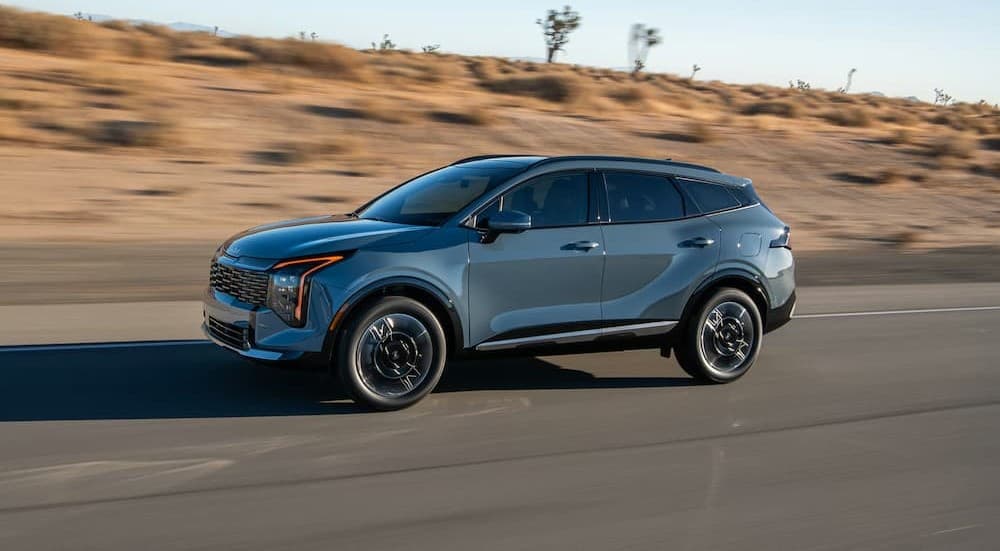
There are few categories as hotly contested as the compact crossover. These smaller SUVs offer a compelling combination of performance, utility, and comfort and have quickly become the most popular segment in today’s market, with a 21% market share. The Kia Sportage has been around since 1995, but has steadily evolved into one of the industry’s most enticing compact options.
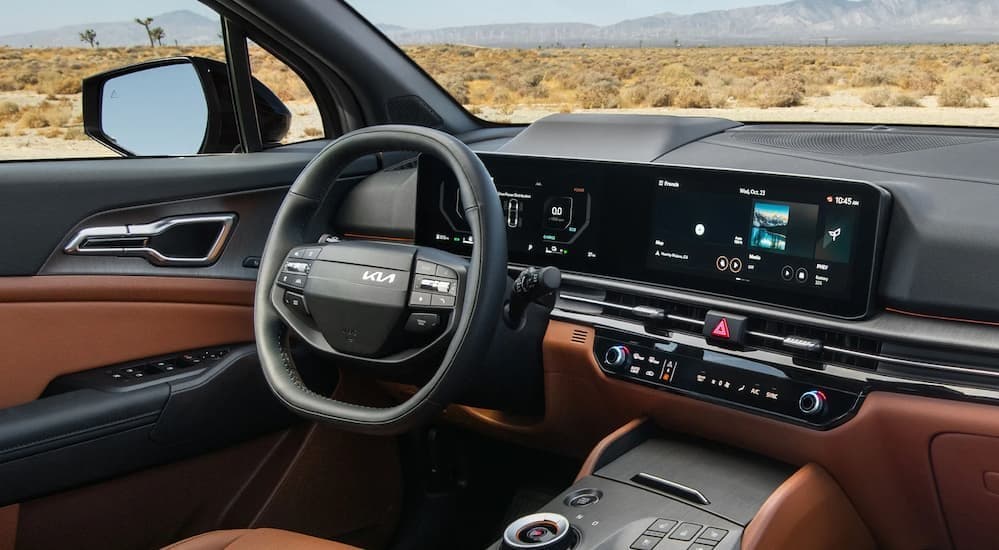
Kia has treated the latest 2026 Sportage to a mid-cycle refresh that brings the crossover firmly into the modern era. The compact SUV gains a new exterior designed to better mesh with Kia’s current “Opposites United” design language, along with a new dashboard complete with dual 12.3-inch displays, but some things haven’t changed.
The Sportage leads much of the compact segment when it comes to both cargo space and rear legroom, two factors that go a long way towards upping the SUV’s appeal in a segment where utility and comfort are often make-or-break factors. Throw in a new remote parking system, optional head-up display, and a new-and-improved version of one of the industry’s best driver-assistance systems, and it’s not hard to see why the Sportage is generating so much excitement.
If you’ve been considering a Kia Sportage for sale near Olathe, you might have noticed that there’s a diverse lineup of powertrains and trims to choose from. While it’s always nice to have options, the sheer selection can make the buying process a little intimidating, but that’s where Cable Dahmer Kia comes in. We’ve compiled a quick guide designed to help drivers choose between the SUV’s three powertrains and eight trims, so buckle up as we walk through some of the key differences between each version of the 2026 Sportage.
What Are the Available Engine Options?
Whether you’re in the market for power, efficiency, or towing performance, you’re sure to find what you’re looking for when you choose the Sportage. Kia offers three distinctly different engines for 2026, ranging from an impressive base engine that offers some of the best towing capacity in its class to a couple of environmentally friendly options in the Sportage hybrid (HEV) and plug-in hybrid (PHEV) models.
2.5-Liter I-4
We’ll start with the 2.5-liter base engine, which, despite its modest four-cylinder design, actually manages to outclass much of the compact segment in terms of pure performance. The entry-level engine offers 187 hp and 178 lb-ft of torque, and can pull up to 3,500 lbs when properly equipped, allowing the Sportage to easily top most of its rivals and offer the sort of utility that’s often difficult to find on the smaller end of the crossover spectrum.
The Toyota RAV4 and Mazda CX-50 both manage to match the Kia’s titanic towing stats, but the rest of the segment gives the Sportage little competition with the Honda CR-V, Hyundai Tucson, and Chevy Equinox all failing to break the 2,000-lb mark. This sort of towing performance might not top every buyer’s list of must-have features, but 3,500 lbs of maximum towing capacity give the Sportage a clear edge in the competitive segment.
1.6-Liter Turbocharged Hybrid
Looking for the best in both sustainability and speed? The Sportage Hybrid is here to serve. Kia has equipped the electrically assisted SUV with a 1.6-liter turbocharged engine that, when combined with two electric motors, gives the crossover serious performance credentials. The hybrid adds more than 40 hp, bringing the Sportage's total to 231 hp and noticeably improving its real-world performance.
While the base engine takes around 9.1 seconds to accelerate from zero to 60 mph, the hybrid version can hit the same speed in just 7.4 seconds. The Sportage Hybrid is also the obvious choice for any Olathe driver looking to reduce pit stops, thanks to an EPA-estimated 44 MPG on the highway with the FWD model. Adding an AWD powertrain does bring that number down to 36 MPG, but the hybrid also offers the best range of any 2026 model, with up to 575 miles per tank.
1.6-Liter Turbocharged PHEV
The PHEV approach offers several advantages over the traditional HEV design, but two specific attributes really set the Sportage PHEV apart from the rest of the lineup. First is the SUV’s all-electric driving range. While HEV models can leverage their electric motors and batteries to handle all of the propulsion duties at very low speeds, these traditional hybrids mainly rely on their gas engines to do all of the heavy lifting. PHEVs benefit from a much larger battery pack -- 13.8 kWh versus the HEV’s 1.49 kWh in the case of the Sportage—which opens the door to a world of all-electric driving.
The Sportage PHEV can travel up to 33 miles without ever tapping into its gas tank, allowing owners to potentially bypass their local gas station altogether. When you do find yourself at the pump, you’ll be able to keep plenty of cash in your wallet with the PHEV Sportage boasting an estimated annual fuel cost of $1,050, which is significantly lower than the segment average at $1,700. The PHEV model is also the speediest setup on offer with a zero-to-60 mph time of 6.9 seconds courtesy of its 268 hp powertrain. That’s a 43% increase in power, and it just goes to show that prioritizing efficiency doesn’t mean missing out on performance when choosing the 2026 Sportage.
A Look at the Trim Lineup
LX
Available On: Gas, HEV
The 2026 Sportage gets off to a strong start with a well-rounded base model that’s difficult to ignore. We’ve already mentioned the base engine’s best-in-class 3,500-lb maximum towing capacity, but the Sportage isn’t just a workhorse. Choosing the LX trim allows buyers to access a generous slate of tech and safety features while still keeping the MSRP below $30,000, which is no small accomplishment in an era of ever-rising prices.
Sportage drivers will enjoy both a 12.3-inch touchscreen infotainment display and a matching 12.3-inch digital gauge cluster, which significantly increases the crossover’s customization potential. The LX also includes a full array of advanced driver-assistance systems (ADAS), ranging from the expected—forward collision warning with automatic braking, lane departure mitigation, and a lane keeping system—to premium features like adaptive cruise control, front and rear parking sensors, and a driver attention warning system.
S
Available On: HEV
The Sportage Hybrid offers a unique S trim that can’t be found on the gas-powered model. The S adds a set of eye-catching 18-inch wheels and a number of comfort-enhancing features like heated front seats and a power-adjustable driver’s seat, as well as an added ADAS in the form of blind-spot warning with rear cross-traffic alert. That said, the real highlight is the trim’s AWD system. The ability to tap all four wheels allows the Sportage to confidently venture into tricky off-road territory or navigate the roads when harsh winter weather hits Olathe.
EX
Available On: Gas, HEV
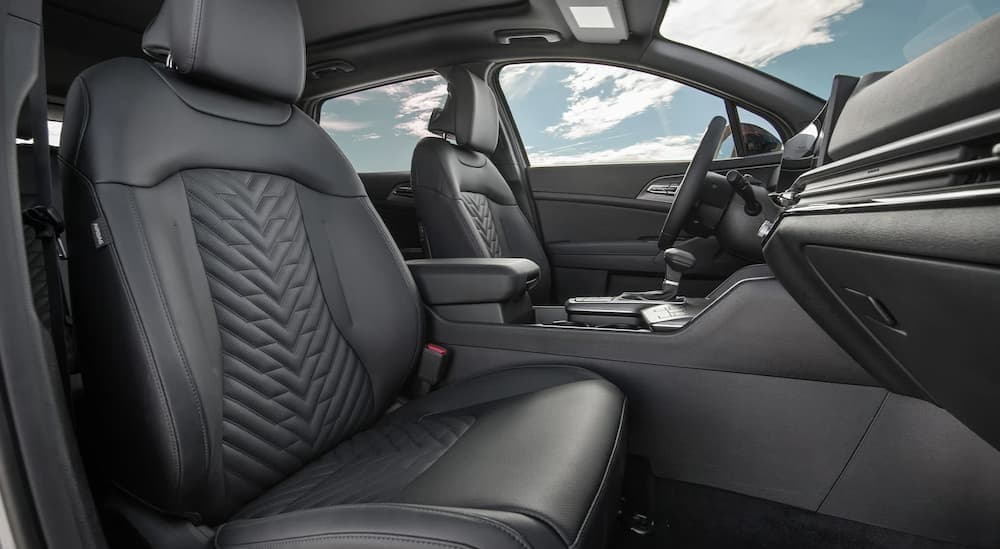
The Sportage EX sees the SUV gain a full complement of modern tech while keeping the price well within the reach of the average driver. The trim features all of the equipment you’ll find on the S, as well as heated front seats, a heated steering wheel, and a dual-zone automatic climate control system that’ll keep you nice and cozy when the temperature begins to drop.
Synthetic leather upholstery gives the interior an upscale feel, as does the remote starter and hands-free tailgate. The tech-forward trim features a wireless smartphone charger and plenty of USB charging ports, not to mention a rear passenger safe-exit system that’ll keep riders from stepping into traffic. An optional panoramic sunroof makes for a bright, airy cabin and adds to the Kia’s aesthetic appeal with LED interior lighting and gloss black roof rails.
SX
Available On: Gas
The SX trim adds a panoramic sunroof and LED interior lighting as standard features, and sets the SUV apart from the crowd with 18-inch matte gray alloy wheels, gloss-black exterior trim, and low-profile roof rails. It’s an eye-catching package by any measure, but Kia has also prioritized comfort and convenience with an integrated GPS navigation system and memory settings for the driver’s seat.
The eight-speaker Harman Kardon premium sound system speaks to the trim’s premium appeal, but it’s the addition of two cutting-edge ADAS that really seals the deal. The SX includes both an intersection collision mitigation feature and Kia’s acclaimed highway driving assist (HDA), which combines adaptive cruise control and automatic lane keeping to take a little of the stress out of your next commute.
SX Prestige
Available On: Gas, HEV
Luxury is the name of the game when it comes to the SX Prestige. Available on both the gas and HEV models, the SX Prestige trim ups the curb appeal with 19-inch gloss-black alloy wheels, LED fog lights, and upgraded LED headlights and taillights. The trim gains Kia’s innovative solar control glass, which features a thin coating designed to block harmful UV rays while allowing the SUV to maintain a steady temperature.
Premium SynTex synthetic leather, a power-adjustable passenger seat, and ventilated front seats speak to the Sportage’s upscale ethos, while an array of cameras and sensors help owners to avoid some common worst-case scenarios. From a blind-spot monitoring system and front, rear, and side parking sensors to a surround-view camera system and rear automatic braking, you’ll always be able to enjoy all of the latest automotive tech when you’re behind the wheel of the Sportage SX Prestige. The SX Prestige also adds an upgraded version of Kia’s HDA system dubbed highway driving assist 2, which we’ll discuss when we dive into the range-topping X-Line Prestige trim.
X-Line
Available On: Gas, HEV, PHEV
The X-Line adds a little off-road attitude courtesy of a unique styling package. The trim backs up its sporty design with a standard AWD system complete with a center-locking differential, plus 19-inch alloy wheels. Gloss black roof rails add to the sporty aesthetic and enable the crossover to carry plenty of cargo, whether you need a little extra storage for your next road trip or are looking to enjoy a weekend full of off-the-grid fun with a rooftop tent.
The X-Line is also the first trim to offer the optional PHEV powertrain, which is tough to beat in terms of speed, efficiency, and all-electric range. The available Premium Package adds the sunroof and interior LEDs, while the Technology package gains many of the goodies found on the SX Prestige, including HDA, the surround-view camera, and a Harman Kardon sound system.
X-Pro Prestige
Available On: Gas
Those eager to explore the road less traveled need look no further than the X-Pro Prestige. Designed to handle the rigors of off-road terrain, the X-Pro Prestige equips the Sportage with AWD, all-terrain tires, and a Terrain Mode system that allows the SUV to excel in a wide range of conditions.
Snow Mode is perfect for dealing with winter weather, limiting torque output, and dialing in the Sportage’s traction control system to provide optimal traction. Mud Mode adjusts the crossover’s shift pattern, torque, and braking force to maintain momentum through slippery stretches of road while Sand Mode serves a similar role in drier scenarios.
The X-Pro Prestige also boasts 8.3 inches of ground clearance, which is a 1.2-inch improvement over the base model. It might not sound like much, but it could make all the difference when you’re trying to avoid rocks, logs, and other common off-road obstacles. The high-end trim also offers plenty of premium tech, including a heated windshield, heated and ventilated front seats, and key ADAS features like HDA and a high-beam assist that leverages a front-facing camera to automatically switch between high- and low-beam headlights. The only downside? The off-road-ready trim is limited to the gas-powered model.
X-Line Prestige
Available On: PHEV
The Sportage X-Line Prestige combines off-road-inspired design with a luxurious approach that’s sure to have you looking forward to every journey. While it’s limited to the PHEV powertrain, the X-Line Prestige makes a strong case for going (partially) electric with its 268 hp and 271 lb.-ft. of torque. Like the X-Pro Prestige, the top trim offers AWD and Kia’s Terrain Mode system as well as premium touches such as automatic rain-sensing windshield wipers, rear privacy glass, keyless entry, and LED lights both inside and out.
The trim even adds a head-up display (HUD) that lets drivers track important data without letting their eyes stray too far from the road, but it’s the model’s Remote Smart Parking Assist (RSPA) and Highway Driving Assist 2 (HDA2) that really have people talking. RSPA addresses one of the most stressful parts of the driving experience, nestling the Sportage into parallel, perpendicular, or diagonal parking spots at the touch of a button. It’s an impressive feat of automation and is the perfect complement to the X-Line Prestige’s HDA2 system.
While standard HDA can handle many of the more mundane aspects of highway driving, HDA2 offers a Lane Change Assist (LCA) feature that allows the vehicle to switch between lanes simply by flicking the turn signal. The AI-powered system also employs machine learning to adjust to your particular driving style and provide a smooth, seamless experience.
There's No Wrong Choice With the 2026 Sportage Lineup
With three engines and eight trims to choose from, there are plenty of options when it comes to selecting your Sportage. The economical base engine allows the Sportage to put in some serious work with a class-leading 3,500-lb towing capacity, and the hybrid powertrain is hard to beat in terms of efficiency at 44 MPG on the highway. The PHEV model splits the difference, offering a significant boost in power and speed while delivering up to 80 MPGe and 33 miles of all-electric range. The LX and S trims offer the sort of value that few compact models can match, allowing buyers to access AWD, the latest ADAS, and twin 12-inch displays.
The EX and SX make major gains in comfort and convenience, but remain competitively priced to suit any budget. The X-Line and X-Pro models add a little off-road flair to the equation, giving Olathe buyers the ability to tackle tough weather conditions and challenging terrain while still serving as a comfortable, efficient option for daily driving.
The Prestige trims add a long list of lavish features, from premium materials and the surround-view camera system to Kia’s solar-control glass and some of the industry’s most advanced automated tech in HDA2 and LCA. If you’re excited about the 2026 Sportage but need a little help narrowing down your options, Cable Dahmer Kia is at your service. Stop by today and see how Kia’s compact SUV can easily elevate your automotive game.

 Warranties include 10-year/100,000-mile powertrain and 5-year/60,000-mile basic. All warranties and roadside assistance are limited. See retailer for warranty details.